

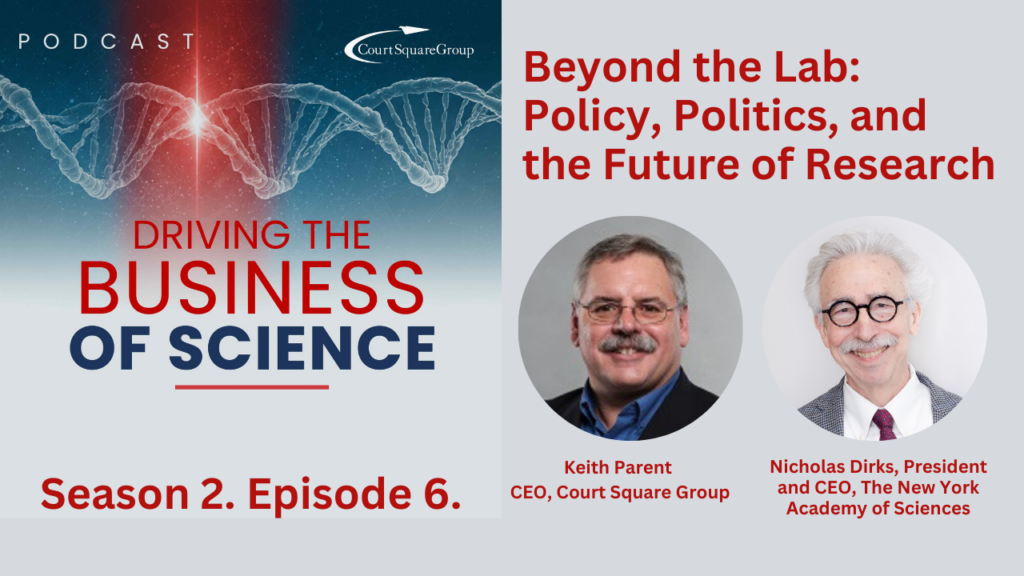
Beyond the Lab: Policy, Politics, and the Future of Research
In this episode of the Driving the Business of Science podcast, host Keith Parent, CEO of Court Square Group, interviews Nicholas Dirks, President and CEO of The New York Academy of Sciences. Nick emphasizes the importance of federal funding for basic research and the need for international collaboration while highlighting the impact of the pandemic and the current administration on scientific research, funding cuts, and the exodus of international researchers. He also explains why the Academy’s efforts to connect scientists from around the world in various fields, including AI and biomedical research, is a crucially important aspect of its overall mission to drive scientific innovation and address global challenges.
Listen on your favorite podcast platforms
iHeart Radio | Apple Podcasts | Spotify | Amazon Music | Buzzsprout
Guest Profile – Nicholas Dirks, President and CEO, The New York Academy of Sciences

Nicholas B. Dirks is President and CEO of The New York Academy of Sciences, one of the oldest scientific organizations in the United States. Previously, Nick served as Chancellor of the University of California, Berkeley, and Executive VP and Dean of the Faculty for Arts and Sciences at Columbia University, where he was the Franz Boas Professor of Anthropology and History. A leading scholar of South Asia who has taught at Caltech and the University of Michigan in addition to Columbia and Berkeley, he is the author of eight books on subjects ranging from the caste system and the British empire to the university. His most recent book is City of Intellect: The Uses and Abuses of the University.
.
Introduction and Overview of Court Square Group
- Keith Parent introduces himself as the CEO of Court Square Group and the host of the podcast.
- Court Square Group is a managed service firm for life science companies, including pharmaceutical, biotech, and medical device companies.
- The firm works with regulatory bodies like the FDA and has various platforms such as ARCC™ (Audit Ready Compliant Cloud), RegDocs365™ (a regulated content and collaboration solution for life sciences), and Life Science LaunchPAD™.
- Keith invites Nicholas Dirks, President of the New York Academy of Sciences, to share his background.
Nicholas Dirks’ Background and Role at the New York Academy of Sciences
- Nicholas Dirks introduces himself as the President and CEO of the New York Academy of Sciences, an organization founded in 1817.
- The Academy organizes scientific conferences, publishes scientific papers, and awards early career scientists in collaboration with the Blavatnik Family Foundation.
- Nicholas has a background in academia, having served as the Chancellor of the University of California, Berkeley, and the Dean of the Arts and Sciences at Columbia University.
- The Academy also offers educational programs and fellowships in various fields, including neuroscience and artificial intelligence.
History and Mission of the New York Academy of Sciences
- Keith expresses fascination with the Academy’s long history and asks about its original impetus.
- Nicholas explains that the Academy was founded by New Yorkers interested in scientific discoveries and natural history in the early 19th century.
- The Academy initially organized dinner parties and lectures with top scientists, growing into a major scientific organization.
- The Academy continues to keep the public informed about the latest scientific and technological breakthroughs.
Impact of the Pandemic on Scientific Research and Funding
- Keith inquires about the impact of the pandemic on scientific research and funding.
- Nicholas discusses the development of the first mRNA vaccines by Pfizer and Moderna and the subsequent political controversies surrounding public health measures.
- The pandemic led to funding cuts for university research, particularly affecting long-term studies in biomedical research.
- Nicholas emphasizes the importance of federal funding for basic science and the potential long-term damage from funding cuts.
Challenges Faced by International Scientists and Researchers
- Keith and Nicholas discuss the challenges faced by international scientists and researchers, including visa issues and funding cuts.
- Nicholas highlights the importance of maintaining a robust pipeline of talented scientists and the impact of funding cuts on early career researchers.
- The number of international students attending graduate schools in the US has significantly decreased, affecting the future of scientific research.
- Nicholas stresses the importance of federal investment and the role of international collaboration in advancing scientific discoveries.
The Role of the New York Academy of Sciences in Connecting Scientists
- Keith asks about the Academy’s role in connecting scientists from different fields and industries.
- Nicholas explains that the Academy has strong connections with universities, industry, and government, facilitating collaboration and innovation.
- The Academy’s conferences bring together scientists from different backgrounds, leading to valuable collaborations and new discoveries.
- Nicholas provides an example of the International Science Reserve, a network of scientists and resources established during the pandemic to respond to future crises.
Examples of Collaboration and Innovation in Scientific Research
- Nicholas shares examples of successful collaborations between scientists from different fields, such as the development of a stent for early cancer detection.
- He mentions the work of Robert Langer at MIT, which involves engineers working with medical researchers to develop new drug delivery systems.
- The Academy’s efforts to connect scientists from different domains help advance scientific discovery and address global challenges.
- Nicholas emphasizes the importance of bringing together diverse talents and technologies to solve complex scientific problems.
The Future of Scientific Research and the Role of AI
- Keith and Nicholas discuss the future of scientific research and the role of new technologies like AI.
- Nicholas highlights the potential of AI to accelerate scientific discovery and improve healthcare outcomes.
- The Academy is exploring the future of new technologies and their impact on scientific research and employment structures.
- Nicholas expresses optimism about the potential of AI to help advance scientific discoveries and address global challenges.
Final Thoughts and Future Collaboration
- Keith thanks Nicholas for the insightful conversation and expresses his support for the work of the New York Academy of Sciences.
- Nicholas reiterates the importance of maintaining a robust scientific pipeline and the role of international collaboration in advancing scientific discovery.
- The conversation concludes with a mutual appreciation for the work being done to drive scientific innovation and address global challenges.
- Both Keith and Nicholas Dirks look forward to future collaborations and continued efforts to advance scientific research.
We are usually asked about
How has the COVID 19 pandemic affected scientific research and funding in the United States?
The pandemic initially accelerated some areas of research, such as mRNA vaccines and public health, but it also disrupted many long‑term biomedical studies. Funding shifts, grant cancellations, and changing federal priorities hit university labs and medical centers particularly hard, often forcing projects to pause or end. Early‑career scientists and postdocs were among the most affected, which may create long‑term gaps in the research pipeline.
Why is federal funding for basic science research so important?
Federal funding makes it possible to support basic science—research where the application is not always known in advance. Many major breakthroughs, including mRNA technologies and synthetic insulin, began as basic research projects in university labs. Without a strong base of federal support, the scientific ecosystem becomes overly dependent on short‑term, applied projects and risks missing transformational discoveries.
What role do international scientists play in the U.S. research ecosystem?
International students, postdocs, and researchers are central to the strength of American science, filling key roles in university labs, hospitals, and industry R&D. Visa challenges, political uncertainty, and reduced opportunities are now discouraging some of this talent from coming to—or staying in—the U.S. Over time, this weakens the scientific pipeline and can erode the country’s global leadership in research and innovation.
How do organizations like the New York Academy of Sciences help drive scientific innovation?
The New York Academy of Sciences acts as a neutral convener, bringing together researchers from universities, industry, and government across disciplines. Through conferences, publications, awards, and initiatives like the International Science Reserve, it helps experts connect, share data, and launch new collaborations. These cross‑sector networks often lead to practical breakthroughs that would be difficult to achieve in isolated labs or single institutions.
How are AI and high performance computing changing the life sciences and clinical research?
AI and high‑performance computing enable scientists to analyze massive datasets, accelerate drug discovery, and model complex systems such as protein folding or disease progression. In clinical research, these technologies can streamline trial design, improve patient matching, and support decentralized trial models with more real‑world data. They don’t replace human expertise, but they significantly enhance the pace and precision of scientific work.